ICDD X-ray Fluorescence Courses
X-ray Fluorescence Courses
XRF I: 20 – 24 April 2026
XRF II: 27 April – 1 May 2026
Let Our Team of Experts Help You Take Your Skills to the Next Level
During the past five decades, the use of X-ray analytical methods has increased in the areas of materials characterization and phase identification. The wide range of applicability of the X-ray fluorescence method has made it a technique employed in thousands of laboratories all over the world.
Over the years, many techniques and procedures have been developed that greatly enhance the versatility of the method. The purpose of the X-ray course is to combine theoretical and practical applications of X-ray fluorescence spectrometry.
Wondering how to take your X-ray fluorescence skills to the next level? The Advanced XRF Course, formerly held at the University of Western Ontario and McMaster University, has now moved to ICDD! The XRF course is presented in two separate week-long sessions, each of which stands alone as a complete class.
Session I
Fundamentals of X-ray Fluorescence is intended for both newcomers to the field and more experienced users seeking to broaden their understanding of fundamental concepts and established procedures. The major emphases are the acquisition of reliable experimental data and qualitative phase identification using manual search techniques, and computer-based methods of qualitative and quantitative phase analysis.
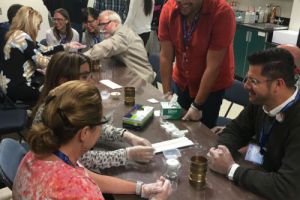
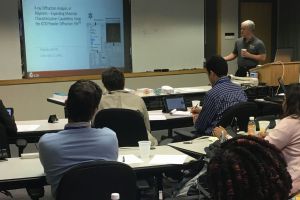
The format of the course is a combination of morning lectures and afternoon recitations and workshops. Ample opportunity for individual student-faculty interaction exists throughout the week, including small recitation and workshop groups and a session where students can discuss their applications and problems with the entire faculty.
Session II
Advanced Methods in X-ray Fluorescence course is designed to teach and practice method development with respect to scope definition, selection and creation of reference material, instrumental settings, and most importantly the mathematical matrix correction and compensation methods for calibration. For maximum benefit from the Advanced Methods in X-ray Fluorescence, the ICDD course faculty strongly recommends that students have previously attended Session I.
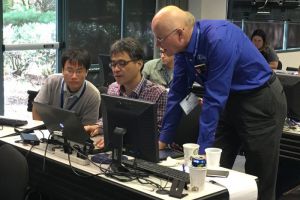
This practical-oriented course alternates lectures and hands-on practical experience to deepen and intensify the material. The class is limited to 16 attendees to ensure individual attention and a focused learning experience. It requires familiarity with Excel to complete the exercises on matrix correction.
Session I Course Outline
Lectures
- Fundamentals of X-ray Physics
- WDX and EDX X-ray spectrometry instrumentation
- Qualitative, semi-quantitative, and standardless analysis
- Introduction to quantitative analysis
- Types and sources of error
- Precision and accuracy
- Calibration strategy
- Drift, line and interelement correction application
- Fundamental parameters
- Maintaining instrument integrity
- Specimen preparation
Workshops
- XRF instrumentation, components, scope, and comparison using live and disabled WDX and EDX instrumentation.
- Selection of parameters for operation
- Demonstration of personal computer exercises in qualitative, semi-quantitative, and standardless WDX and EDX analysis
- Demonstration of personal computer exercises employing polynomial regression, line overlap, empirical and fundamental parameter corrections during calibration
- Specimen preparation lecture and demonstration of the use of mixers, grinders, presses, fusion apparatus, etcetera
- Discussion of problems encountered by participants
Session II Course Outline
Lectures
- Recap of XRF Basics
- Method Development the way from start to finish
- Defining Scope, Detection, Quantification limits, and Tolerances
- Reference Materials
- Preparation selection and constraints
- WDX: Getting the “right” Net intensity: background correction, overlap correction, spectral contamination corrections; EDX decomvolution methods
- From Net intensity to Concentration: Overview of Matrix compensation/correction methods
- Internal standard methods and Compton Correction
- Fundamental parameters: the fluorescence process explained and calculated
- Influence coefficients: Emprical and theoretical approaches
- Borate Fusion: Making recipes – Flux selection; Dilution and mixing
- Calibration, validation, and drift correction
Practical
- WDX: Net intensities correcting for background spectral interference and tube contaminations
- EDX: Deconvolution models and settings
- 3-element manual calibration in Excel
- Making synthetic standards with Borate fusion, mixing and fusion
- Sample Prep: enrichment techniques, powder and liquids
- Sample Prep: solids polishing and cutting
When & Where
XRF Session I – Fundamentals of X-ray Fluorescence: 20 – 24 April 2026
XRF Session II – Advanced Methods in X-ray Fluorescence: 27 April – 1 May 2026
Convince Your Boss!
ICDD Headquarters
12 Campus Boulevard
Newtown Square, PA 19073-3273 USA
Phone: (610) 325-9814
If you have any questions, please contact education@icdd.com
What's Included
The registration fee for this course includes:
- Lecture, workshop, and lab materials
- Catered lunch Monday through Thursday
- Coffee and snack breaks
Schedule
Classes are held:
- Monday: 8:30 am to 6:00 pm
- Tuesday: 8:30 am to 4:30 pm
- Wednesday: 8:30 am to 4:30 pm
- Thursday: 8:30 am to 5:45 pm
- Friday: 8:30 am to 12:00 pm
Faculty
The course faculty is selected from academic, industrial and government institutions under the direction of ICDD.
- Larry Arias
- Dr. Meredith M. Daniel-Prowse
- Dr. Andy Drews
- Maggi Loubser
- Dr. Julia Sedlmair
- Alexander Seyfarth
- Eric Smith